About Me

My photo
I must share that "Ms. Math" is my teacher-superhero alter ego. My first year of teaching I had a lovely young lady who simply couldn't bother to remember my name, so she called me Ms. Math. "Ms. Math" found a way to connect with this especially challenging student, so this persona is my source of teacher strength!

Thursday, October 9, 2014

Friday in Italy!

Buon giorno again from Italy!  As I write this post, I am finishing up my time in Vico Equense, and about to head to Rome for the last part of the trip.  I have really enjoyed reading your comments, and am happy to see most of you had no trouble at all with the math!

Just like the last post, I will ask some questions for you to answer.  To answer the questions, please write a comment in which you address each question from this post.  You might find that you need to use the internet (i.e. a Google search) to find extra information to help you answer the questions!  Suggestion:  write your response first in Microsoft Word, then copy and paste it into a comment on the blog---this way, any issues with the internet will not cause you to lose your typing.  As usual, please respond in complete sentences that are specific and have any necessary supporting details!  Some of these questions will center on math, while others will not.

Ercolano (Herculaneum)

Today we visited some ancient Roman ruins of a town called Ercolano (Herculaneum in English).  This town was quickly destroyed in the year 79 AD when Mount Vesuvius erupted suddenly.  Unlike the more famous town of Pompeii which got covered in ash, Ercolano was covered in a thick mud that turned to stone and nearly perfectly preserved the town and everything in it, including organic materials that usually decompose or disintegrate such as wood and rope.  The most interesting fact I learned at the Ercolano ruins was that the sea is now 700 meters farther away from the town than it was prior to the eruption in 79.  This is because the eruption was so massive and violent that it sent mud, rocks, and ash in such great volume that sea level was pushed back.  Research three facts about Mt. Vesuvius that you find interesting.  

A Comma or a Period?

One thing that I've noticed while here is that numbers are expressed a little bit differently.  I was buying a snack the other day, and the price tag said 1,50 euros.  At first I thought the decimal must just look like a comma, but the more I looked around, the more I realized that there were commas in all of the prices instead of decimal points.  After further observation, I noticed that larger numbers were expressed with periods where we use commas!  For example, instead of writing three-thousand as 3,000, it would be expressed here in Italy as 3.000, and six and a half would be 6,5 instead of 6.5.  Which way of expressing numbers is more logical? Why?  Consider the purpose of a comma versus a period in grammar.

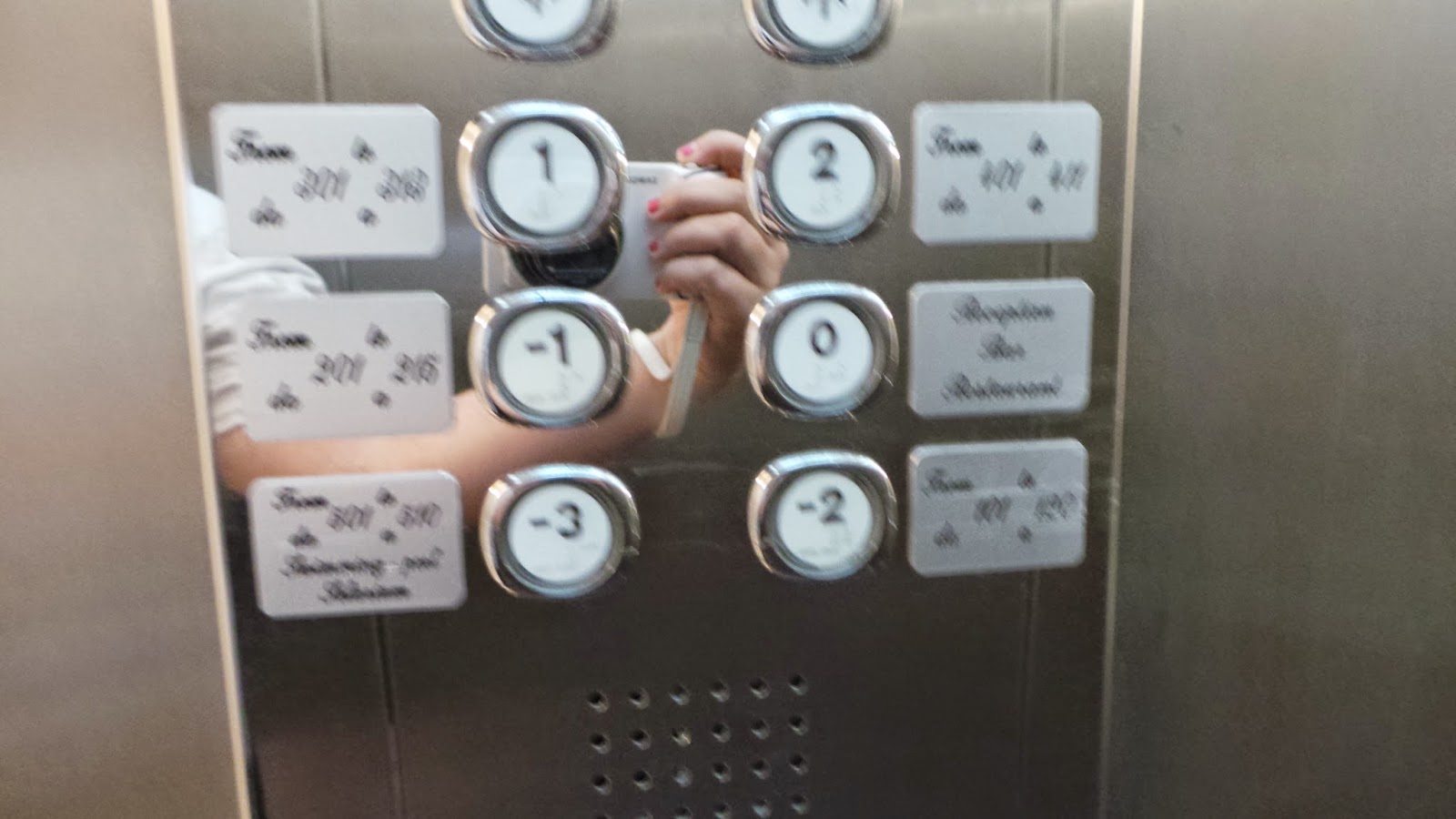
Something else I've noticed is how the floors are numbered in buildings--it's done in a way that really makes sense!  The floor you enter on is floor 0, then it counts up as you go up a level, and counts back into the negatives as you go down a level.  I am staying two levels below the entry level, so I am on floor -2 in this hotel!

When in Rome...

As we get ready for the last part of the trip in Rome, I am very excited to see some sites here.  I have been to Rome once before, but there is so much to see that I can't wait to do it again!  I hope to see the Vatican and its museums, including the famous Sistine Chapel.  Also on my list of sites to see are the Pantheon, the Trevi Fountain, the Colosseum, and the Forum, to name a few.  Use the internet to find a tourist map of Rome.  Can you make an estimate of how far I might walk if I walk between all these sites?

Do you need to do the math?

Based on what you've read in these blog posts, as well as perhaps your own personal experience, do you think it is important to have a basic understanding of math when traveling? Why or why not?  Write at least 3-5 sentences elaborating on this question!


Wednesday, October 8, 2014

Wednesday in Italy!

Wednesday Blog


Buon giorno from Italy!  My travels so far have been very fun, and I’ve been learning a lot as well!  I trust that you all are enjoying Ms. Palen and being the wonderful students I know you are!  


I am going to tell you all a bit about what I’ve been doing so far while here in Italy.  I’m sure this comes as NO surprise to you, but I’ve been encountering math ALL OVER THE PLACE!!  Traveling is always a great example of why it’s important to have some strong fundamental math skills.  As I tell you about the trip, I will ask some questions for you to answer.  To answer the questions, please write a comment in which you address each question from this post.  You might find that you need to use the internet (i.e. a Google search) to find extra information to help you answer the questions!  Suggestion:  write your response first in Microsoft Word, then copy and paste it into a comment on the blog---this way, any issues with the internet will not cause you to lose your typing.  As usual, please respond in complete sentences that are specific and have any necessary supporting details!


Arriving in Italy


I departed from the Raleigh-Durham Airport last Friday, making a stop at JFK Airport in New York, then flying to Rome, Italy.  I arrived in Italy at 7:35 am on Saturday morning.  I wanted to call my family to let them know I arrived safely, but I first needed to consider what time was it in North Carolina when I arrived in Italy?  I then had to travel by a series of trains to my first destination, Sorrento.  I boarded a train that left the airport at 8:08 am and took 32 minutes to get into the main station in Rome—Roma Termini.  I knew there were trains that departed from Roma Termini at 8:45 am and at 9:40 am.  Which of those trains do you think I was able to catch to my next connection city, Naples?  The train ride to Naples took about 70 minutes, and then I had to catch one more train (which also took about 70 minutes) after a brief layover in the Naples train station.  Can you estimate when I arrived in my final destination of Sorrento?  These were important calculations for me to do so that I could alert the hotel shuttle of my arrival time.  


Once in Sorrento, I explored the area around my hotel, rested, and ate dinner.  The cost of my dinner was 30 euros.  About how many U.S. dollars did I spend on my dinner? 


I then had to make a decision about what I was going to do on Sunday.  My fiancĂ© had to be at conference in the next town over by 16:00 (they use 24 hour time here, how would we express 16:00 at home?).  We hoped to go to Capri, a small island with beautiful scenery and grottos (coastal caves).  The first boat for Capri departed Sorrento at 9:40 and took 20 minutes to get to Capri.  The tour of Capri and its most famous grotto (Grotto Azzuro) was suggested to take approximately 3 hours.  In order to catch the last bus of the day to the train station, we would need to be back to Sorrento by 12:30.  Do you think we had time to go to Capri on this day? Keep in mind that separating was not a choice, it's much safer to travel with a buddy!


Okay, spoiler alert, here’s a freebie: we did not have time to go to Capri on Sunday.  Instead, we explored the city of Sorrento.  We saw the local port and marina, a few small beaches, ruins of an old mill, and even some ancient Roman ruins.  We explored an old church, went in and out of shops, and enjoyed beautiful views of Mount Vesuvius across the Gulf of Naples before having lunch in the main square of the city.  We then took a 10-minute train ride to Vico Equense, the town in which we would be spending the next 5 days.  The train departed at 14:22.  What time did we arrive in Vico Equense, expressed in non-24 hour time (they way we would display the time in NC)?  The first day in Vico Equense consisted of exploring the town and having dinner.  


Vico Equense, like much of the region here, is elevated above the water.  The towns and cities are perched on mountains and cliffs on a peninsula that is surrounded by the Gulf of Naples to the north and the Gulf of Salerno to the South.  The next day, Monday, I decided I would hike down and explore the part of town that was at sea level.  On the map, the route I picked appeared to be about 400 meters long.  What I did not account for was the descent when estimating the length of my hike.  My starting point was 90 meters above sea level.  About how far did I actually walk for the round trip?  This one might be a little tricky for Math 1 students, Math 2 students, you should know how to figure it out for sure! You can assume that my horizontal distance was exactly 400 meters and my vertical distance was exactly 90 meters.  


That evening, I went to a restaurant for dinner called Pizza a Metro (Pizza by the Meter).  The people in Vico Equense say that THIS is the town where pizza was invented, and this restaurant served pizza by the meter, just as it’s name suggests.  Imagine a giant pizza that is a meter long and about 20 cm wide!  The menu says that a meter of pizza would serve 5 people.  Since there are 36 students in Math 1 & 2, how many meters of pizza would we need for a pizza party in Vico Equense?


Hopefully you can see that while I am not using complex or advanced math, it has been very important for me to understand fundamental math for dealing with time, currency, and distance.  I look forward to reading you comments on this post, and telling you more about the trip later this week!  Ciao!


Check out these photos of the trip so far:

Note: Please excuse any typos on this post, I only have Internet access on my phone here. Feel free to let me know if you notice any spelling or grammar errors!

Tuesday, August 27, 2013

Back to School!

Today was my first day with kids, as yesterday there were no pullouts so that core teachers could begin to build community and have time to go over classroom procedures.  I started with Math 2, and they already got a taste of India...

We were going to review basic rules of exponents today, and so I started with the following pictures and a question: "What do you see?"


We not only had an awesome discussion about the MATH I was hoping to review, but we looked at many differences in the classroom environment such as:

  • how the date is written
  • the uniforms and matching hair for the girls
  • the students two to a desk
  • the student standing to speak
  • the number of students in the room
  • the word "indices" where we would use "exponents"
Our discussion focused on what we thought was being taught.  We discussed what else might have been in the lesson that we can't see, and then were able to use this as a jumping off point for some work of our own.  WAY better than standing up and giving a lecture on a bunch of math rules the kids already know.

Thursday, July 18, 2013

Pune to Delhi

Monday morning after our wonderful and restful host family weekend, we ventured out to visit two businesses in Pune.  First, we visited SAS India, which is meaningful both because of SAS's Cary, NC headquarters and because of the fact that they sponsored me and a few other teachers for this trip.  Thanks, SAS!  SAS shared with us many of their business structures and also gave us context about what's happening with the software/IT boom in India and specifically in Pune.  They pride themselves on being ranked as one of the top companies to work for in India, in the US, and worldwide.  We toured their offices, and then they treated us to a delicious lunch!


Next, we had a quick session with a real estate developer that manages a planned township in which SAS India is located.  Much like in the States, these all-inclusive (schools, stores, restaurants, housing, businesses, medical, etc.) suburban communities are popping up around cities to accommodate the growing IT industry.
After leaving this township, we headed for the Serum Institute.  The Serum Institute is one of the world-leading manufacturers and distributers of vaccines.  They manage to keep costs down and supply vaccines at low cost to NGOs and world organizations.  We toured their facility, seeing everything from labs to production lines to warehouses. 


It was all business that morning, and then it was time to head to Delhi.  We arrived at the Pune airport which functions dually as an Air Force base and a 6-gate international airport.  Security was intense--they zip-tied our checked luggage once it was screened and searched nearly half of our carry-on bags.  The flight was smooth, and a few hours later we were on the ground in Delhi.  We deplaned onto the tarmac, and it was HOT. Like really really HOT.  We squeezed onto a bus to head for baggage claim.  It didn't take too long before we were on our next bus headed for our next hotel, the Maidens.  The Maidens is a pretty amazing five star hotel, so we're being a little spoiled here.


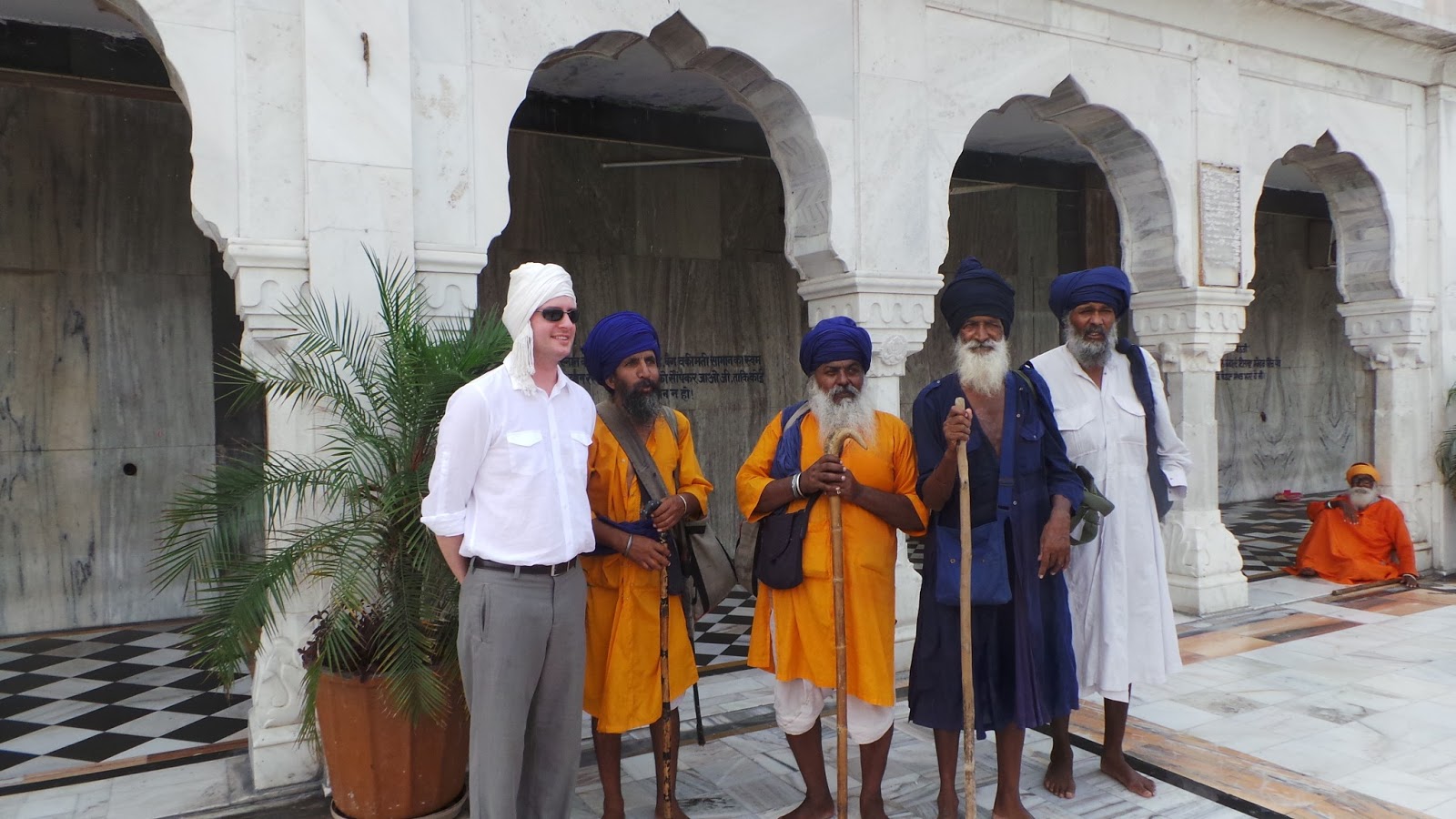
Our first day in Delhi was spent touring sites such as the largest Sikh temple in India, India Gate, the Lotus Temple, and Humanyun's tomb.  Additionally, we got to meet and talk with Dr. Shashi Tharoor, India's Minister of Human Resource Development (the department which houses education).  His presentation and perspective offered more insight and context to much of what we have seen and experienced thus far.  Our day included an amazing lunch at a restaurant called Lodi Garden, in which we had wonderful conversation and enjoyed the typical afternoon rain under the protection of a garden patio roof.  That night, we took it easy on the food, and a big group of us ordered Domino's pizza to the hotel.


Our next day, Wednesday, was another packed schedule.  We first visited FabIndia, a retail clothing company that has an innovative supply chain model that employs and empowers artisans and craftspeople to preserve Indian craft tradition while still making a profit.  They made a short presentation to us on this, and then, of course, we shopped at FabIndia.  I got myself another kurta (correctly spelled this time), as well as a few gifts for those at home.  Next we headed to Dilli Haat, a municipal market for local artisans.  Before shopping in the market, we had lunch at Navdanya, and organic restaurant run by an NGO that aims to preserve biodiversity and local farming by fighting corporate agriculture and companies like Monsanto... sound familiar?  We also heard from Navdanya's founder, Dr. Vandana Shiva about some of their initiatives and progress.  We were able to do some shopping at Dilli Haat, but the heat and humidity was overwhelming, and we didn't hate having to get back on the bus with AC.  


From Dilli Haat we went to Qutub Minar, a 12th century Muslim mosque and stone tower.  The heat was still taking it out of us, so from here we went to a restaurant called Magique where we would spend the evening debriefing, socializing, and enjoying dinner.  Again, we had some great conversation, and I was overwhelmed with joy and gratitude for everything I've had the opportunity to experience thus far.